
Dianka and Tomchik
A story revived from Olga Perovskaya's Kids & Cubs


I.
When I was a child, Alma-Ata was 400 miles from the nearest railway. Its population was very small, and if a single automobile appeared on the streets in the course of a year, everyone within running distance would leave whatever they were doing and dash out to see the miracle on wheels.
In those days all the houses were one-storied. They looked like little mushrooms peeping out from among branching trees.
We lived in a little house with a large orchard. There were many apple-trees, but, more important still, there were many pets, both farm and wild animals, that were growing up together with us.
Every time my father went hunting he would bring back live baby animals. We fed them, took care of them and brought them up ourselves.
Each of us had our own special pet - one had a lively fox-cub, another a baby donkey and my youngest sister had a guinea-pig.
"I'll bring you back a wolf-cub," Father promised me.
"A wo-o-lf? Oh, no! That's too scary. It's too hard to tame a wolf. Bring me something else instead, won't you?"
"I hope you're not serious," Mother said. "It'll bite the children and scratch them and run away."
"Oh, you scaredy-cats! Are you really frightened of a tiny wolf-cub? Too bad, because wolves can become wonderfully tame."
And he told us the true story of a tame wolf.
II.
The wolf loved its master like the most devoted of dogs. It followed him everywhere, it protected him from his enemies and guarded his horse whenever they went on trips. Its only shortcoming was that it liked to drink. As soon as the wolf smelled liquor, it would go sniffing about the house until it finally found the bottle. Then it would roll it about the floor until it broke and it would lap up the wine.
"After the wolf drank all the wine did it become as noisy as Timka Frolov?" we asked. "Did it break dishes and fight?"
"No, it never did anything like that. It would just crawl into a corner and go to sleep."
"And then what?"
"And then, when it woke up, it would be just as clever and hard-working as before."
"That's not what I meant. What happened afterwards?"
"Afterwards? Well, its master had to go far away travelling by coach and train. The man didn't know what things would be like in his new place of work, or whether they would want to take him on with a wolf. So he decided to give the wolf to his friends. But the wolf didn't want to live with them. Then the man took it to a forest. But the wolf found its way back and got home before the man did. Finally, there was nothing to be done except put it to sleep. The man gave it some medicine and the wolf collapsed. Its master was terribly grieved. He got into a carriage and set out.
After travelling for some time he noticed that his wolf was loping along after the carriage. The dose of medicine had been too small. The wolf soon revived and dashed after its master. From then on the wolf travelled in the carriage with him for nearly five hundred miles to the nearest railroad. Then they went by train and by boat. The man said the wolf was his dog, and it behaved so well that no one ever doubted his word. The wolf lived to a ripe old age and they never parted again."
"How wonderful!" we all said. "Now tell us another story about wolves."
"What's the use of telling you stories? I'll bring you back a live wolf-cub and you can take care of it yourselves. Then you'll be able to tell me interesting things, not the other way round."
From then on I would nag my father every single day: "Where's my wolf-cub? You promised me one. Where is it?"
III.
And then one morning when I was still asleep someone came over to my bed and said in a very loud voice:
"Get up! They've brought him!"
I knew exactly what it was. I jumped out of bed, pulled on my clothes and dashed out into the yard.
"Run to the smithy!" Father shouted after me. There was a deserted smithy in a far corner of the yard where all kind of junk, like rusty iron, broken sledges and broken dishes, was dumped. The door to the smithy was tightly closed and a big stone was placed against it. I pulled the door open a crack and squeezed in. It was dark inside. Coming in from the bright sunshine I couldn't make anything out.
Suddenly I heard a rustling sound from under the hearth, where the blacksmiths make their fire. Four bright-green eyes shone in the dark. I shuddered and tried to back away. I didn't think I would ever be afraid of a little wolf-cub, but this one... this one had four eyes!
"Silly! There are two of them."
The cubs growled. Judging by the noise they made, they were creeping farther under the stove.
I already knew that the best way to make friends with an animal is to give it something to eat. I ran back to the kitchen, filled a bowl with milk, soaked some bread in it and took it to the smithy. I left the door ajar so that some light would enter. Then I set the bowl on the earthen floor and hid in the darkness.
The cubs were afraid to come close to the food. A long time passed. But they were hungry and it did smell delicious.
Finally, a tiny grey muzzle peeped out. It was immediately joined by another. The cubs crawled out, looked around and crept cautiously towards the bowl.
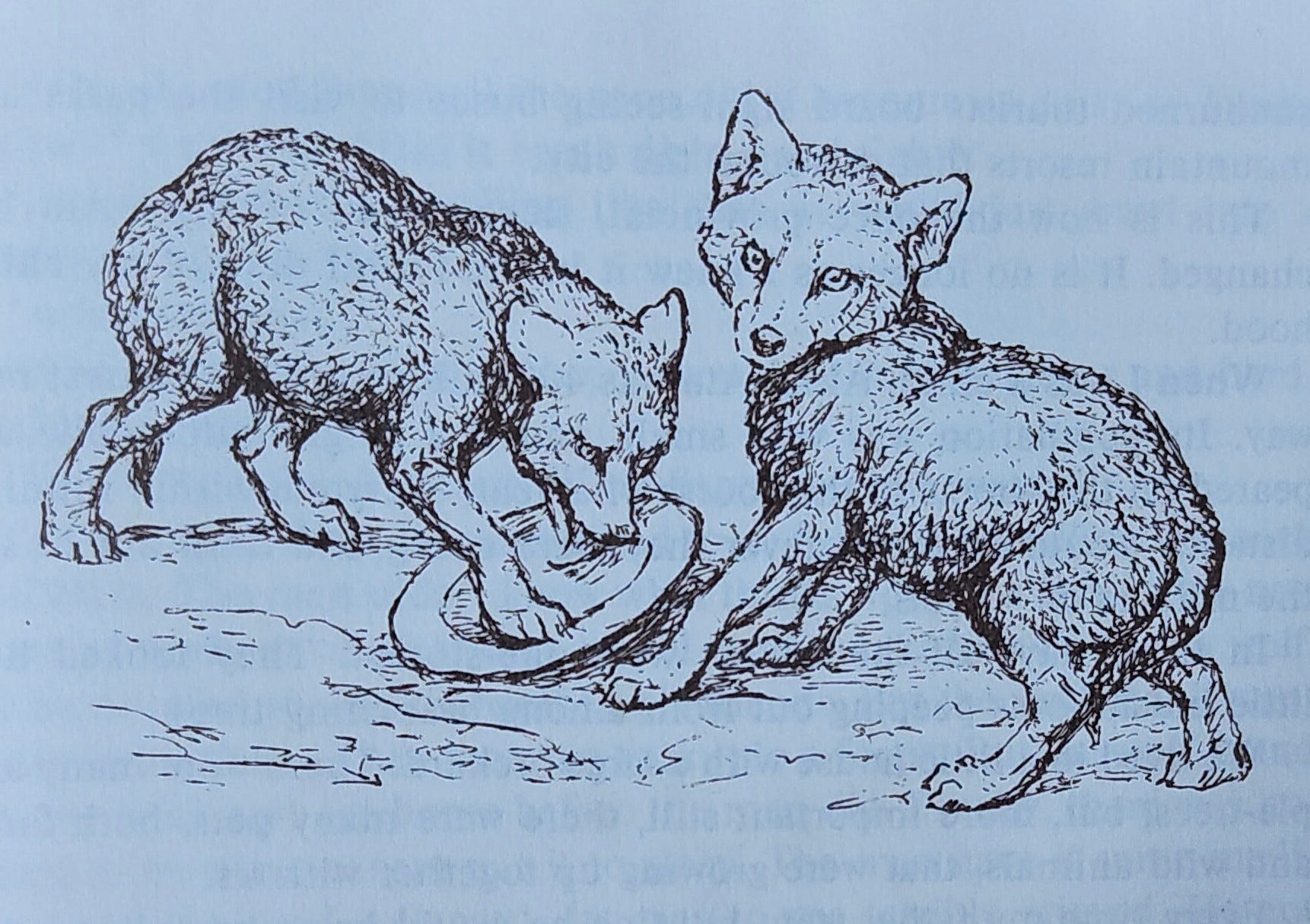
Here they forgot their fear. Standing with their paws spread far apart, they fished out chunks of bread, shivered, choked and jostled each other. Since they had to swallow and growl at the same time, they kept choking and coughing right into the bowl, making the milk bubble.
They were so busy eating they did not notice me. I tiptoed up very close.
The cubs were just like puppies, they had large round bellies and large paws. The only difference was that their tails were thinner and not as furry and their ears were stiff and pointed.
Soon there was nothing left in the bowl, but the cubs were not through with it yet. One had all four feet in it and was licking it clean. The other raised its head, started and stared at me. I saw that it was confused, so I smiled and put my hand out to pat it.
Snap!
I barely had time to pull my hand away. The cub darted back.
What a mean thing he was! Though still a baby, he wouldn't let anyone pat him. Why, he nearly bit my finger off! And what had I done? I had given him some bread and milk. Well, I'd show him!
I didn't try to force my friendship on the cubs, but to tell the truth I felt hurt.
The children surrounded me when I came out into the yard.
"Did you see the wolves? What are they like?"
"They’re excellent wolves," I replied without batting an eye. "They're nearly used to me already and they obey me. Now I have to think of names for them."
We sat down on some logs nearby and began to think. Father had said that one was a male and one was a female, and so we named them Tomchik and Dianka.
IV.
At noon I brought them some more food and called to them, making little clucking sounds.
The cubs crawled out and began to eat. I opened the door wide.
Our dogs looked into the smithy. I was afraid they would attack the cubs and wanted to chase them away, but the cubs ran to them with their tails between their legs and big smiles on their faces. They tried to lick the dogs' noses, they rolled over on their backs and kicked their feet in the air and played up to them just like real puppies would. They probably thought the dogs were wolves, and that is why they were so happy.
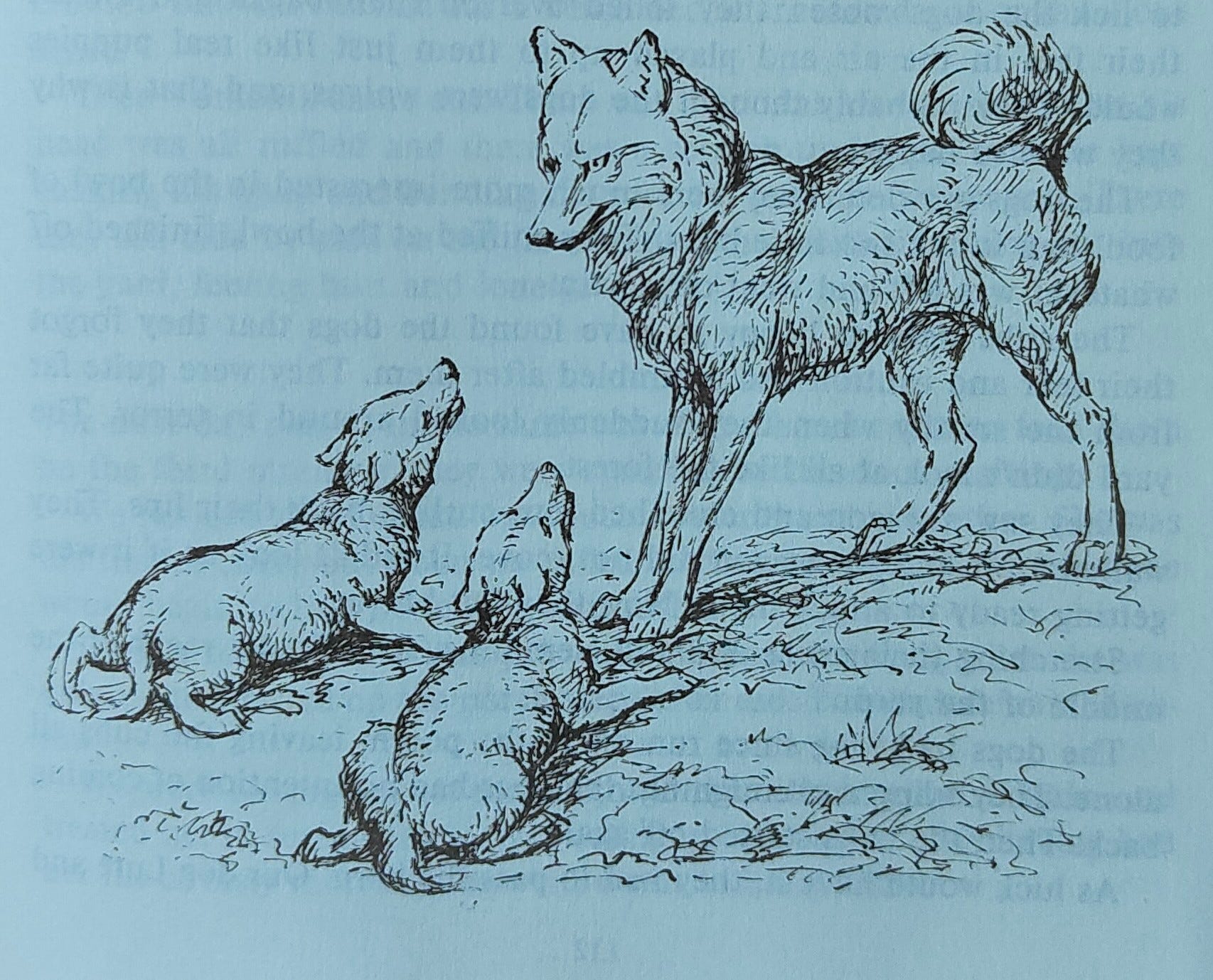
The dogs growled. They were much more interested in the bowl of food than in the two little cubs. They sniffed at the bowl, finished off whatever was left and went out again.
The cubs were so happy to have found the dogs that they forgot their fear and caution and scrambled after them. They were quite far from the smithy when they suddenly looked around in terror. The yard didn't look at all like the forest.
They saw a wagon and crouched low, curling back their lips. They waited a bit, but the wagon did not move. It didn't look as if it were getting ready to attack them. Now they felt braver.
Stretching their necks and still trembling, they finally reached the middle of the yard.
The dogs had long since run off to the porch, leaving the cubs all alone. They whined pitifully, but the dogs had no intention of coming back. Then the cubs started off again.
As luck would have it, they had to pass the barn. Our dog Lute and her new-born puppies lived under the barn. Lute decided that the cubs were after her puppies and came flying out at them. She grabbed Tomchik by the scruff of his neck and shook him angrily. We came running to the rescue.
Lute let him go. Then both he and Dianka ran off to the smithy, crawled far under the stove and were quiet.
Poor Tomchik! Look what had happened to him on his very first outing!
We crowded round the smithy guiltily, peering under the stove, calling gently to the cubs and pushing all sorts of tasty titbits towards them. They were good enough to eat our offerings, but their only response was an angry growling.
However, no matter how hurt their feelings were, they couldn't stay under the stove long. Dianka was the first to stick her head out. She crawled out, sat outside for a while and then darted under the stove again.
Then Tomchik came out. There was blood on his ear, the fur on his head was all ruffled and there was a scratch under his eye. He kept shaking his head and bending his sore ear towards the ground.
There they sat, side by side on the threshold of the smithy, looking out into the yard, feeling hurt and lonely.
V.
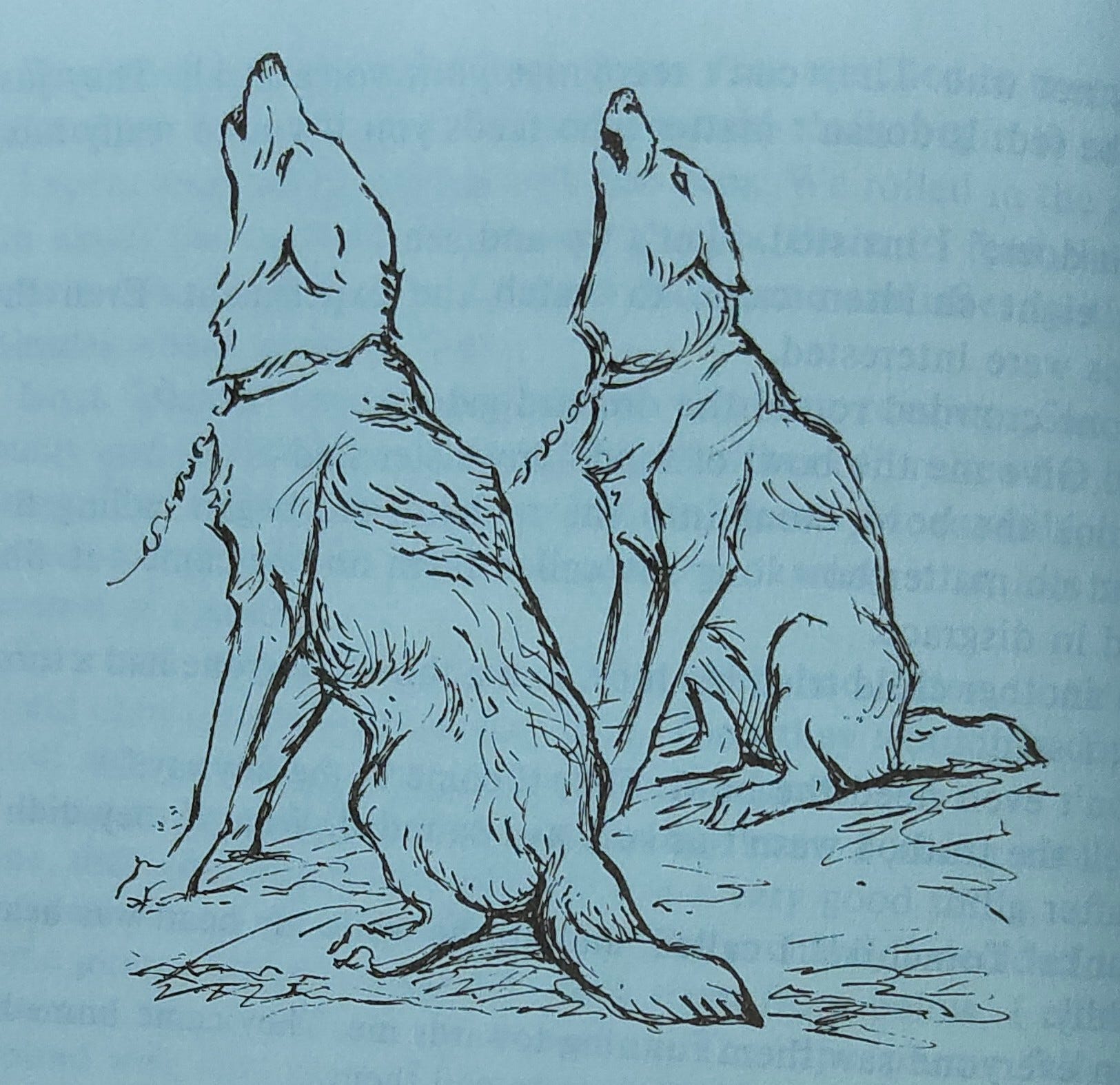
In a few days, Dianka and Tomchik knew every nook and cranny of the orchard, but they rarely came up to the house, because they didn't like company. I was the only human being they accepted and loved. They would come to greet me, nuzzle close to me, jump up and put their paws on my shoulders and lick my hands and face.
Once I boasted that the cubs knew my voice and could recognise it from among all others.
Everyone made fun of me.
"That's not true. They can't recognise your voice at all. They just come to be fed. It doesn't matter who feeds you if you're really hungry."
"Yes, it does," I insisted. "Let's try and see."
About eight children came to watch the experiment. Even the grown-ups were interested.
Everyone crowded round the orchard gate.
"Wait! Give me the bowl of food," my sister said.
She took the bowl, went into the orchard and began calling the cubs. But no matter how long she called them no one came out. She returned in disgrace.
Then another child tried his luck, and a third. Everyone had a turn.
Finally, I said:
"I don't even need the bowl. They'll come to me anyway."
To tell the truth, I wasn't as sure as I sounded. What if they didn't come after all?
"Dianka! Tomchik!" I called, and all the while my heart was beating wildly.
Then everyone saw them running towards me. They came immediately, they had been waiting for me to call them.
"See! And you said they couldn't recognise my voice!”
VI.
The summer was coming to an end. The cubs had grown considerably, and the dogs had become very respectful. When Dianka and Tomchik had been very small the dogs had paid no attention to them. But things had changed now, and they would often come to visit my pets.
One day the dogs came running into the orchard. They raced round the trees, barked, yelped with pleasure and tumbled about. It was a dazzlingly bright morning. The ground was soft, and the fallen leaves were so tempting the dogs just had to bury their noses in them. They tossed up piles of leaves and seemed unable to stop even for a moment. It was as if someone had wound them up and now the springs were making them go.
The cubs were excited by the dogs and soon joined the game. Dianka smacked Tomchik sharply with her paw, darted away, crouched and waited, as if to say: "Come on, Tomchik! Let's show them how wolves play!"
Then pandemonium broke loose. In no time Dianka was racing away from Zagrai, while Lute was pulling Tomchik's tail. When he whirled around and knocked her over she was not at all offended. She jumped up, shook herself and continued the game with even more spirit than before.
From then on the dogs came to the orchard every day. Dianka and Tomchik would sometimes follow them back into the yard. The dogs and the wolves became real friends.
THE END (or is it?)
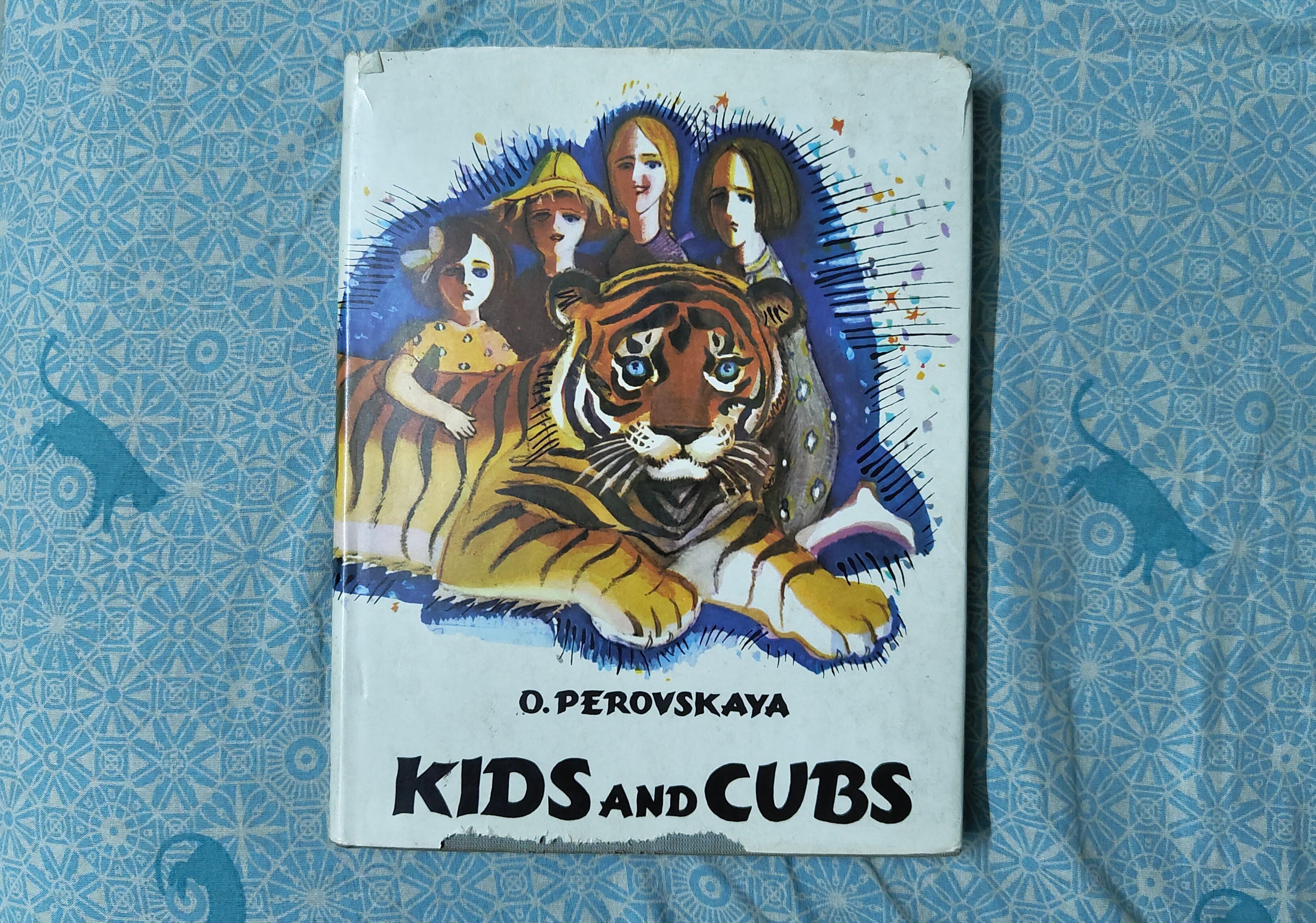
(Translated from the Russian by Fainna Glagoleva. Drawings by V. Vatagin and I. Godin. First published in 1966 by Raduga Publishers, Moscow)
Oh my lord! I was gifted this as a child :) one of my most favourite books. Lovely to see it make an appearance.